
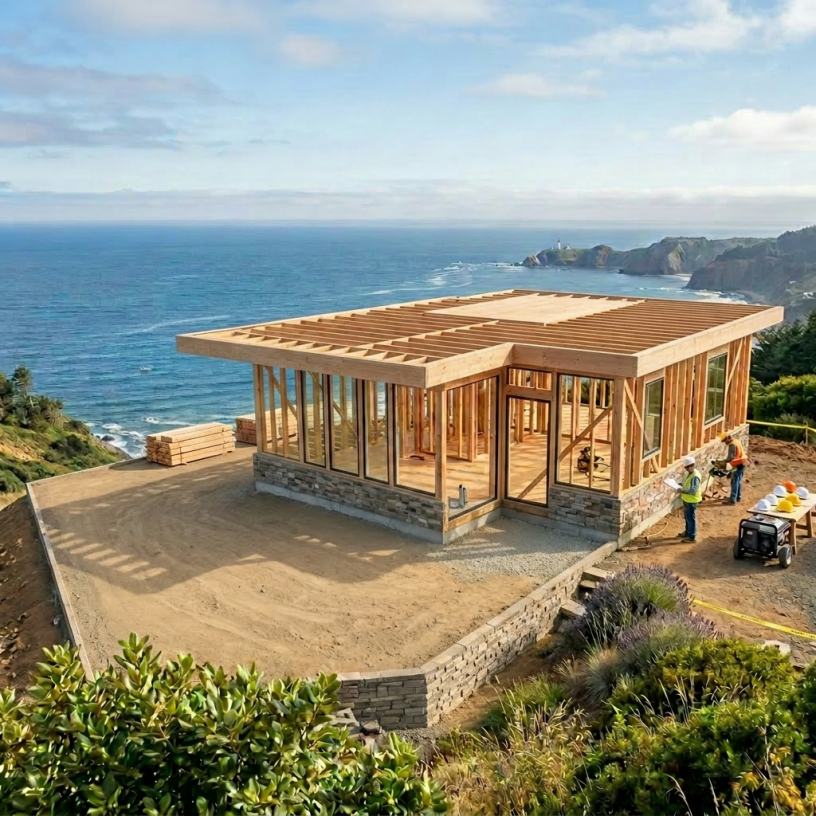
A recent demurrer ruling in Rassekhi v. Cheng signals that homeowners rebuilding fire-destroyed homes cannot treat the neighborhood’s recorded view protections as a dead letter — and that the long-dormant one-story height limit may be back in play.
The January 2025 wildfires that swept the Pacific Palisades left hundreds of lots cleared to the dirt. As rebuilding accelerates, a question that seemed settled for a decade is suddenly live again: do the recorded view covenants that govern neighborhoods like Marquez Knolls still restrict what can go up on those lots? A June 23, 2026 ruling from the Los Angeles Superior Court suggests the answer, at least for ground-up reconstruction, is yes.
The dispute
In Rassekhi v. Cheng (Case No. 26STCV02044), several homeowners sued a neighbor whose home, destroyed in the fire, is being rebuilt on the downhill, ocean-facing side of the tract. The plaintiffs allege the new structure — with changes in square footage and a higher roofline than the pre-fire house — will obstruct their views in violation of the tract’s CC&Rs.
The defendant demurred, arguing that even if every allegation were true, the claims failed as a matter of law. The court disagreed. It overruled the demurrer as to the central breach-of-CC&Rs claim and the declaratory relief claim, allowing both to proceed, while giving the plaintiffs leave to replead two secondary “nuisance” and “negligence” theories.
The headline takeaway: the view-covenant claim survives, and it survives because of how the court treated the rebuild.
Why this was supposed to be a loser — and why it isn’t
In 2019, the Court of Appeal in Eisen v. Tavangarian (2019) 36 Cal.App.5th 626 held that the view rights protection provided in ¶11 of the CCRs did not apply to alternations (remodels) of existing home.
¶11 provides: “No fences or hedges exceeding three feet in height shall be erected or permitted to remain between the street and the front setback line nor shall any tree, shrub or other landscaping be planted or any structures erected that may at present or in the future obstruct the view from any other lot, and the right of entry is reserved by the Declarants to trim any tree obstructing the view of any lot.”
The court Eisen reversed a 2005 case, Zabrucky v. McAdams (2005) 129 Cal.App.4th 618, which held that ¶11 applied to remodels. Unfortunately the California Supreme Court denied a petition to review to reconcile Eisen and Zabrucky. Since Eisen, the trial courts have applied it over Zabrucky. (Please contact me if you have information otherwise.)
It is worth being precise about what Eisen actually held. The Marquez Knolls CC&Rs contain three relevant provisions.
Paragraph 1 caps homes at one story, with a narrow exception for an approved two-story dwelling.
Paragraph 2 required architectural-committee (later homeowners-association) approval of building plans — but that approval requirement sunset by its own terms.
Paragraph 11 bars “structures erected” that obstruct a neighbor’s view.
Eisen held that neither paragraph 1 nor paragraph 11 restricts the renovation or alteration of an existing residence. Its reasoning was textual: paragraph 11 speaks only of structures “erected,” and omits the word “alter,” so it reaches outbuildings and new construction — not remodels of a home that is already there. Alterations had been governed solely by paragraph 2, and paragraph 2 had expired. The net effect was a widely shared assumption that Marquez Knolls view covenants had little practical force.
That assumption rests on a word the post-fire rebuilds cannot claim: existing. Eisen freed alterations to an existing residence. It said nothing that frees the construction of a brand-new home on a lot where the prior structure has been reduced to ash.
Point one: a fire rebuild is an “erection,” not a renovation — so paragraph 11 applies
This is the distinction the Rassekhi court seized on. A home destroyed by fire is no longer an “existing residence” to be altered or remodeled. Rebuilding it is the erection of a new structure — the precise activity paragraph 11 reaches.
Under Zabrucky v. McAdams (2005) 129 Cal.App.4th 618, which Eisen left intact on this point, paragraph 11 prohibits erecting a structure that “unreasonably obstruct[s]” the view from any other lot. The Rassekhi court applied exactly that standard, reasoning that paragraph 11 permits “erecting” a dwelling only where it does not unreasonably obstruct a neighbor’s view — and that whether this particular rebuild does so is a question of fact that cannot be resolved on a demurrer.
The significance for the Marquez Knolls homeowners is hard to overstate. Eisen’s renovation exemption is the homeowner’s best friend when the project is a remodel. It is irrelevant when the project is a teardown-and-rebuild — and after the fire, an entire neighborhood’s worth of projects are exactly that. The covenant that everyone assumed was toothless turns out to have its sharpest application in precisely the situation the Palisades now faces.
Point two: the one-story limit applies too
The less obvious — and for rebuilding owners, more consequential — point is that paragraph 1’s one-story height cap should also apply to new construction as well.
Paragraph 1 sets the rule plainly: no structure may be “erected” other than a one-story dwelling, except that a two-story dwelling “may be erected” where, “in the judgment of the Declarant and approved by the Architectural Committee,” it “will not detract from the view of any other lot.” The exception, in other words, is conditioned on two approvals: the Declarant’s judgment and the Architectural Committee’s sign-off.
Neither approval can be obtained today. The Architectural Committee’s powers ended on December 31, 1980, and the successor homeowners-association powers ended on December 31, 1995. There is no longer any entity authorized to approve a two-story dwelling under paragraph 1’s exception.
That matters because of how paragraph 1 is built. Eisen let alterations escape paragraph 1 by noting that its two-story clause says “erected,” not “altered” — so it does not govern altering an already-approved home. A ground-up rebuild closes that escape hatch: erecting a new dwelling is unquestionably an “erection.” And once the project is an erection, the two-story exception is unavailable, because the bodies that alone could grant it no longer exist. What remains is the default: one story.
Notably, the Eisen court expressly declined to decide “whether a single-story residence could now be remodeled to add a second story.” The appellate court left that door open. The post-fire rebuilds walk straight through it — and they do so on the strongest possible facts, because they involve new erection rather than the alteration Eisen was careful to cabin its holding to.
The takeaway for owners rebuilding in Marquez Knolls
The demurrer ruling in Rassekhi is not binding precedent but hopefully other Judges hold that the Eisen renovation exemption does not travel to the rebuild context. Owners and design professionals who assumed the view covenants were a formality should reassess before committing to plans that raise rooflines or add a second story:
- A fire rebuild is new construction, and paragraph 11’s “unreasonably obstruct” standard may still apply to it.
- Paragraph 1’s one-story cap very likely governs that new construction, because the two-story exception now has no one left to approve it.
- A neighbor with a protected view has a viable claim — and the leverage to litigate it — well before the framing goes up.
For a neighborhood rebuilding all at once, those are not abstractions. They are the rules that will shape the Palisades skyline for the next generation of homeowners.
This article is for general informational purposes and reflects commentary on a tentative ruling that is not final and may change. It is not legal advice, and reading it does not create an attorney-client relationship. Anyone facing a specific view-covenant or rebuilding question should consult qualified counsel about their own circumstances.

